So it's the last month of school, and you are marvelling that your students are still toting around those swollen backpacks. Why won't they shed some of their papers and keep them at home? Why won't they recycle some of the unnecessary weight? Isn't some of it ready for the circular file? If you could just get them to explore some of that extra bulk, would they part with any of it?
Here's a fun end-of-year writing assignment that allows writers time to analyze their archives. Wallets, purses, pockets are also places where something usable may be tucked away.
What's this all about? Let's say that you are starting a museum display that represents your students' 8th grade lives. You want one item from each child with a detailed paragraph for an exhibit label.
Their labels should reflect the importance of their contribution to the collection. What is this object? What's its history and significance to the exhibit? I encourage students to write fiction, non-fiction or a combination of both. Writers glue/tape their artifacts to a sheet of paper right alongside their descriptive paragraph. If you have the time and space, it would be fun to actually put these on display in your classroom and allow classmates to browse the collection.
Agenda pages, doodles, movie tickets, candy wrappers, food packaging, notes, programs, small toys, photographs-- these are just a few items from this year's contributions.
This is a flexible assignment that you will enjoy reading.
Thursday, June 9, 2011


Wednesday, June 8, 2011
End of Year Found Poetry Kit
This is a simple student-made poetry kit. You will need glue sticks, 3 x 5 note cards, envelopes and scissors. Ask students to look through their collection of papers and choose an assignment or worksheet that they would not mind destroying. (I think it's best that the assignment NOT be a math worksheet, but I'm sure some math geniuses see the poetry in numbers.)
Students will cut out 25-30 words. They will put the words and the note card in the envelope. Then, they will trade envelopes with someone who is also ready his/her kit. The writer will create a poem using some/all of the words in their classmate's kit. Children glue the words to the note card. Voila. Done.
This activity can be done using magazines and newspapers as source material, but this version is cheaper. I also like helping students find ways to entertain themselves with what they already have.
Students will cut out 25-30 words. They will put the words and the note card in the envelope. Then, they will trade envelopes with someone who is also ready his/her kit. The writer will create a poem using some/all of the words in their classmate's kit. Children glue the words to the note card. Voila. Done.
This activity can be done using magazines and newspapers as source material, but this version is cheaper. I also like helping students find ways to entertain themselves with what they already have.
Tuesday, June 7, 2011
Hello, I'm Johnny Cash.
My favorite classroom art was completed by last year's geometry students. I was "babysitting" them while most of the 8th grade was taking the course three SOL. Our art teacher even let us borrow her classroom, so we felt like real, live artists.
First, I found a couple of photographs of Mr. Cash on line that I liked. My real, live artist boyfriend made us the patterns you see below. We then planned out which colors would go where.
 |
| The patterns for the collage. These were traced on poster board and cut out. |
http://www.allposters.com/-sp/Three-Folk-Musicians-1967-Posters_i1813743_.htm
Designated student pasters worked on different pieces of the collage. You can really see the beauty of the technique in the guitar below. We pieced it all together on a piece of red poster board.
 |
| The finished collage before strings, frets, tuning pegs and lamination. |
Mr. Cash kept watch over the back left corner of my classroom behind my desk on the side of a file cabinet. He took on some water in my classroom when the tornado raised the roof. The seal of the lamination didn't protect him from mold. When I heard that the storm hit my school, I couldn't help but think of his song "Five Feet High and Rising."
Just yesterday, a parent of one of my current students sent me word of an end-of-year gift for my new classroom. She is also a sub, so she had seen my Johnny Cash art.
Here's what's on its way to me right now:
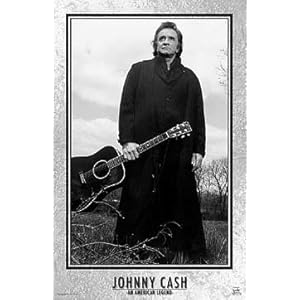
What's not to love?
Note: You certainly don't have to be an artist to facilitate such activities in your classroom. Leaf through some Scholastic Art magazines, see the lesson plans they've created and modify them to suit your curriculum, time constraints, needs and abilities. You won't believe the beauty that emerges.
Monday, June 6, 2011
Stress Relief

I like to bake cornbread when I am feeling the weight of stress. It's not a family recipe. I started with the directions on the back of a package of Indian Head yellow corn meal and adjusted it until I felt like it was right. I have my grandmother's sifter and her sunshine yellow Pyrex mixing bowl. Like I said before, it's not her recipe, but she sure did love to bake. I like to think about her standing at her own kitchen counter while I am standing at mine. It's a simple task that brings me a lot of peace.
I'm sharing my recipe with you and hope that you also have a few "healing ceremonies" that you use when you need them. Also, Southerners can't write this long without mentioning food, so I finally gave in to the impulse.
First:
Before you are wild-eyed with hunger, take two eggs out of the fridge to reach room temperature. Ideally, these eggs should be of the local, fresh variety.
Meanwhile:
Set the oven for 400 degrees F.
Drip a little sunflower oil in your favorite cake pan.
Sift the following into the same bowl:
1 c. corn meal
1 c. cake flour
1 tsp. salt
3 tsp. baking powder
1/2 c. sugar
Pour the following in a smaller bowl/ container:
2/3 c. buttermilk
1/2 c. sunflower oil
When your eggs hit room temperature, beat them with a fork and get rid of any whites that seem stringy.
Next, plop eggs in the smaller bowl and beat them to combine with milk/ oil.
Pour into the bowl of dry ingredients. Mix with your fork.
Make sure your pan is lightly coated with sunflower oil.
Pour the batter into the pan.
Depending on your pan, it will take roughly 20-25 minutes.
It's done when you can press your palm lightly on the top of the cake and the cake springs back.
Top with honey and butter.
Jump back. Kiss yourself. Have mercy.
Saturday, June 4, 2011
Headlines
As you know, alliteration is the stuff that tongue-twisters are made of. According to dictionary.com, it's "the commencement of two or more stressed syllables of a word group either with the same consonant sound or sound group (consonantal alliteration), as in from stem to stern."
You will need 1 regular die and 1 20-sided die from a Scattergories game. You are ready to teach alliteration. Roll 'em. If you get a 1 on the regular die, or a vowel on the Scattergories die, roll again.
The object of this games is to create alliterative headlines. Say you roll a 3 and a T. Your headline could be Thumbelina Throttles Thor. Grrrrr. This is a fun way to spend a few extra minutes of class, or introduce alliteration to your masses. You may choose to award the most ridiculous headlines; writers generally want to share their creations when it comes to this game.
Keep your eye out for Scattergories when you visit thrift stores. There's also a good chance that you have a friend with a dusty edition of that game who would be happy to set it free from storage.
You will need 1 regular die and 1 20-sided die from a Scattergories game. You are ready to teach alliteration. Roll 'em. If you get a 1 on the regular die, or a vowel on the Scattergories die, roll again.
The object of this games is to create alliterative headlines. Say you roll a 3 and a T. Your headline could be Thumbelina Throttles Thor. Grrrrr. This is a fun way to spend a few extra minutes of class, or introduce alliteration to your masses. You may choose to award the most ridiculous headlines; writers generally want to share their creations when it comes to this game.
Keep your eye out for Scattergories when you visit thrift stores. There's also a good chance that you have a friend with a dusty edition of that game who would be happy to set it free from storage.
Friday, June 3, 2011
Highlights
For those of you joining us from another state or another country, Virginia's 8th graders take two state assessments in language arts. We administer the writing test in early March. Students must pass a multiple choice portion that focuses most heavily on editing, but includes other parts of the writing process. They must also write a short paper that is evaluated in three domains: composing, written expression and usage/mechanics. It's the essay portion that I want to talk with you about today.
A great tool that Virginia's Department of Education made available to teachers and students is the NCS Mentor Program. It's a collection of scored student essays that were written for the writing assessment. You are able to show students what passing and failing papers look like. Essays have been scored in each of the three domains, so if you are giving a lesson on written expression, you can zero in on papers that illuminate those techniques well.
My favorite part of the NCS Mentor is the color-coded overlay feature. If you choose that option in viewing a paper, you get to see a student's essay evaluated with annotations that are linked to a color.
I wanted to translate the color coding idea into something manageable for my writing classroom. Two of the materials that I require for class are pink and green highlighters. I decided to equate pink with "pause" and green with "go."
Here's what I know about 8th grade writers. Many students don't really know when or how they got it right or wrong when it comes to writing. Often, they don't have the right vocabulary to pinpoint what works and doesn't work in their essay. It's like looking at a great piece of art when you don't have the language to evaluate it. Your gut tells you it's great, but what techniques is the artist using to please your eye and move your heart? In addition to giving students the reasons why part of a piece does not work, we need to give them the language to explain why other parts do. For example, "You are right to organize your story chronologically, but your word choice is flat and the lack of elaboration does not let the reader visualize what is happening." This book can help you comment on student work http://amzn.com/0439796024.
Where do the highlighters come in? When students are revising, I ask them to identify their best parts in green and the parts that need help in pink. Sometimes when I am evaluating a paper, I use the highlighters as well.
The highlighting task can have a smaller scope. For instance, if you are teaching students the beauty of word choice, ask them to highlight their vivid language in green before turning their paper in to you. If they are unable to make any highlights, they have already discovered that they do not have mastery of the skill. They should revise before turning the paper in to you. It's so important for writers to critique their own work. Every now and then we do some peer editing, but that's not a realistic scenario, is it? And peer revising is just too much to ask. Really. Writing is work. Writing is craft. Expect to sweat a little.
Highlighters, colored pencils, pens, crayons...it doesn't really matter what students use.
Also, if you administer the VA writing SOL, check the directions. This year students were allowed one colored pencil to use for editing and revising their draft...not on the final though. It looks like the DOE caught on to the good idea they shared with teachers through the NCS Mentor. And guess what? Students used those pencils. What's better than giving students techniques that they can carry with them throughout their writing lives?
For an in-depth look at the new curriculum framework for 8th grade writing, look for pages 73-79 after you click "6-8" at http://www.doe.virginia.gov/testing/sol/standards_docs/english/review.shtml
A great tool that Virginia's Department of Education made available to teachers and students is the NCS Mentor Program. It's a collection of scored student essays that were written for the writing assessment. You are able to show students what passing and failing papers look like. Essays have been scored in each of the three domains, so if you are giving a lesson on written expression, you can zero in on papers that illuminate those techniques well.
My favorite part of the NCS Mentor is the color-coded overlay feature. If you choose that option in viewing a paper, you get to see a student's essay evaluated with annotations that are linked to a color.
- Red = Central Idea
- Green= Elaboration
- Blue= Unity
- Purple= Organization
I wanted to translate the color coding idea into something manageable for my writing classroom. Two of the materials that I require for class are pink and green highlighters. I decided to equate pink with "pause" and green with "go."
Here's what I know about 8th grade writers. Many students don't really know when or how they got it right or wrong when it comes to writing. Often, they don't have the right vocabulary to pinpoint what works and doesn't work in their essay. It's like looking at a great piece of art when you don't have the language to evaluate it. Your gut tells you it's great, but what techniques is the artist using to please your eye and move your heart? In addition to giving students the reasons why part of a piece does not work, we need to give them the language to explain why other parts do. For example, "You are right to organize your story chronologically, but your word choice is flat and the lack of elaboration does not let the reader visualize what is happening." This book can help you comment on student work http://amzn.com/0439796024.
Where do the highlighters come in? When students are revising, I ask them to identify their best parts in green and the parts that need help in pink. Sometimes when I am evaluating a paper, I use the highlighters as well.
The highlighting task can have a smaller scope. For instance, if you are teaching students the beauty of word choice, ask them to highlight their vivid language in green before turning their paper in to you. If they are unable to make any highlights, they have already discovered that they do not have mastery of the skill. They should revise before turning the paper in to you. It's so important for writers to critique their own work. Every now and then we do some peer editing, but that's not a realistic scenario, is it? And peer revising is just too much to ask. Really. Writing is work. Writing is craft. Expect to sweat a little.
Highlighters, colored pencils, pens, crayons...it doesn't really matter what students use.
Also, if you administer the VA writing SOL, check the directions. This year students were allowed one colored pencil to use for editing and revising their draft...not on the final though. It looks like the DOE caught on to the good idea they shared with teachers through the NCS Mentor. And guess what? Students used those pencils. What's better than giving students techniques that they can carry with them throughout their writing lives?
For an in-depth look at the new curriculum framework for 8th grade writing, look for pages 73-79 after you click "6-8" at http://www.doe.virginia.gov/testing/sol/standards_docs/english/review.shtml
Thursday, June 2, 2011
When students read aloud in reading class...
Let me interrupt myself to weigh in on having students read aloud in class. I don't make anyone read aloud in my classroom in front of the group. I take volunteers. Well, I take some of them. I try not to be harsh, but there are some students who would go on and on during the whole class period without modulating their voice a single time. Although this makes a great teachable moment since the class is unlikely to ever forget what the word "monotonous" means, it tortures your captive audience needlessly and nothing is added to their understanding of the piece.
Especially with struggling readers, I do not ask them to do any "cold readings" unless I am sure that they will be successful. Yes, round robin reading does not happen in my room. I may pre-assign paragraphs or passages and give readers a chance to preview and practice. I need students to focus on the meaning of the words, not their dramatic performance in class.
A few years ago, I was so thrilled when my target class read scene after scene of "The Diary of Anne Frank" aloud. They read it like they knew what had happened, was happening and would happen. Wow!
Even so, much to my disappointment, they could not even answer basic comprehension questions on the scenes they had just finished. All they were able to do was to keep up and tread water. I didn't build in enough time for them to pre-read or re-read. They needed an opportunity to think quietly about what was taking place on the page.
On the other hand, advanced readers will power through this particular play quickly and understand most of it. Your not-so-careful readers will miss some of the finer nuances that happen when you think about the stage directions in conjuntion with the lines, but they will get the big ideas.
Before you ask students to read aloud, make sure that it will be to the benefit of the class and that the student is prepared enough to be successful.
If you would like another opinion regarding round robin reading, here's Ms. Laura Robb's take on the subject, http://blogs.scholastic.com/laurarobb/2010/03/please-bid-farewell-to-round-robin-reading.html
Especially with struggling readers, I do not ask them to do any "cold readings" unless I am sure that they will be successful. Yes, round robin reading does not happen in my room. I may pre-assign paragraphs or passages and give readers a chance to preview and practice. I need students to focus on the meaning of the words, not their dramatic performance in class.
A few years ago, I was so thrilled when my target class read scene after scene of "The Diary of Anne Frank" aloud. They read it like they knew what had happened, was happening and would happen. Wow!
Even so, much to my disappointment, they could not even answer basic comprehension questions on the scenes they had just finished. All they were able to do was to keep up and tread water. I didn't build in enough time for them to pre-read or re-read. They needed an opportunity to think quietly about what was taking place on the page.
On the other hand, advanced readers will power through this particular play quickly and understand most of it. Your not-so-careful readers will miss some of the finer nuances that happen when you think about the stage directions in conjuntion with the lines, but they will get the big ideas.
Before you ask students to read aloud, make sure that it will be to the benefit of the class and that the student is prepared enough to be successful.
If you would like another opinion regarding round robin reading, here's Ms. Laura Robb's take on the subject, http://blogs.scholastic.com/laurarobb/2010/03/please-bid-farewell-to-round-robin-reading.html
Subscribe to:
Posts (Atom)