Saturday, March 10, 2012

Getting Away With Murder


This could be the title for so many books about the Civil Rights Movement, but this time it's referring to The True Story of the Emmett Till Case, a book by Chris Crowe.   I had requested this book for our library years ago, but I actively avoided reading it.   I already knew young Emmett's story; I discovered it when I was nearly as old as he was when he drew his last breath.

I don't mind telling you that I was not a stellar student in middle school.   In 8th grade, I do remember charting facts about the Vietnam War and being fascinated by the Tinker v. DesMoines Supreme Court Case.   And then there was the quarterly poetry memorization requirement.   25 lines per quarter in 7th grade, 50 in 8th.   Oh, the dread with which I went to school those days in anticipation of standing before my peers, drawing a blank and perhaps fainting on the spot.   This medieval expectation was responsible for some of the most visceral memories of conducting research I've ever experienced.   I'm pretty certain that my English teacher did not plan for my new obsession, nor did she ever know about it.

Yes, we are getting to Emmett Till, but it started with the four little girls.   I was researching poet Dudley Randall in preparation for presenting "The Ballad of Birmingham."   The poem galloped along in a sing-song rhyme while recounting truly horrific circumstances.   These were the days of microfilm and microfiche, trips to the public and local college libraries and getting taxied around by my dad.   I don't remember talking to him about what I was sifting though.   When something of such great magnitude weighs on my mind, I usually get quiet and look for more information.   That meant Medgar Evers, Mickey Schwerner, Andrew Goodman and James Chaney.   Next was Emmett Till.

A black teen down from Chicago after his 8th grade year was visiting relatives near Money, Mississippi.   In what seems to be a case of teenage boy bravado, he took up a challenge from friends and tried to flirt with a young white woman working behind a store counter.   Till was later taken from his relatives' home in the middle of the night, tortured and murdered.  

Days after his disappearance a white teen found Till's body in the Tallahatchie River.   This is the image that I remember as I scanned the pages of Jet magazine.   Till's grieving mother, Mamie, made a chilling decision on behalf of a nation.   She insisted on an open casket funeral and allowed Jet to publish the photographs.   This was no ordinary open-casket.   Her child was nearly unrecognizable.   His body was almost doubled in size due to being under water for so long; his face was distorted from the vicious beating as well.   This was her child, and she wanted everyone to see him.  

Young Till is called "the boy who triggered the civil rights movement."   He predated Rosa Parks's act of civil disobedience, and it was Medgar Evers who assisted in finding witnesses for the case against Till's murderers.   Years later Evers would be shot on his front doorstep after arriving home from work while his children raced to the other side of the door to greet their father.  

Show me an 8th grader, and I'll show you someone who is very interested in justice.   These lessons came to me when I was ready to hear them, but as an adult, I didn't want to read about the case all over again.

If you read my earlier post about the summer seminar I've applied for, you'll remember that the course centers on Clarkesdale, Mississippi.   One of the required books is Getting Away With Murder: The True Story of the Emmett Till Case.   No, I haven't been selected yet, but I thought it was time that I faced that book.   It arrived a couple of weeks ago, but I still wasn't ready.   I wrapped it in a favorite flannel pillowcase and placed a heart milagro on top of it and slid it in a wooden drawer.   This may seem strange to you; it seemed strange to me too.   I got the book out today and read it quickly.   Yes, that photograph is in there, but I feel that the complex story was handled in a way that would reach most teens without frightening them away first.   The book is just over 120 pages and keeps a narrow focus.   Photographs add even more gravitas to Till's story.  

Like I said before, I already knew this story, but here's something that I did not know.   At the time of jury selection, "Mississippi state law required that only registered male voters who were at least twenty-one years old and could read and write were eligible for jury duty.   Even though 63 percent of the residents of Tallahatchie County were Black, the pool of prospective jurors contained only white men because Tallahatchie County has no Black registered voters" (79).   Although I had studied the events surrounding the Voting Rights Act, I never made the connection that the right to vote also impacts jury selection in a very basic way.

Now that our 8th grade social studies is civics, not world geography, I look forward to compiling a unit on the Civil Rights Movement.   The way that so many young people affected widespread social change should be inspirational for most teens.   As adults, we already know that social justice starts with just one person "being the change."   It's good to introduce this idea to teenagers while they are hungry and idealistic.   Sure, some of the battles they may take on will seem to lack "great social import," but they are advocates in training.   This will be the foundation of thought for the defining moments in their future when they will have to choose a side that represents their idea of integrity.

Chris Crowe's non-fiction book I mentioned was actually a collection of his research for writing Mississippi Trial, 1955, a piece of historical fiction.   I have not read it yet as I prefer my history to be as factual as possible, but it comes highly recommended by a self-proclaimed reluctant teen reader.   Okay, sometimes she says she "hates" reading, but I prefer to assume that's hyperbolic.

And don't miss A Wreath for Emmett Till.   It's a spellbinding masterpiece.
Product Details

Now Put a Little Soul in it

On August 4, 2006 NPR's All Things Considered featured a story on the Kashmere Stage Band.   These talented Houston musicians were at their peak during the late 60s and early 70s.   Everything was on time and outta sight.   And they were a high school band.   Yep.   Can ya dig it?   I knew that you could.

I'm not going to spend too much time here telling their whole story.   You need to hear it for yourself!   Check them out on iTunes.   Or you could get started with the trailer from Jamie Foxx's 2010 documentary.


Do you see how long I've been waiting for this film?   Can you do the math?   And you know it did not come to a theater or kiosk near me.   Thanks to Amazon and a recent shopping binge, I got my own copy of the DVD in the mail this week.

Truth be told, I can't play a lick.   And, yes, I'm an English teacher with important classwork for students to master, but oh how I treasure their time with the arts.   If I could, I would be a music, art, reading and writing teacher all at the same time.   These are all subjects in which students can find a voice and a vehicle for self-expression.  
The best days in the classroom are when children can engage, participate and share.   Please don't put your head down.   If you're sick, please go to the nurse.   The classroom is a community of learners.   Your contribution is valuable.   It's not the same when you're not with us.  

Sometimes it's a struggle keeping everyone on board, but in many ways it must be similar to looking out over a sea of band students.   When there's a "man down" in band, you notice.   Band doesn't work that way.   I think that's part of why I admire great band teachers so much.   Everyone gets to play; everyone has to play.   Who shows up to band thinking they are going to get away with doing next to nothing?

No matter what you teach, don't let band a chorus be the only classes that students are taught the value of song.   Need a little help with that?   Here are some free lesson plans from the Rock and Roll Hall of Fame and Museum.

If you get a chance to watch Thunder Soul, please do.   It's a love song to a great man, Mr. Conrad Johnson.   In a time when Rev. Jesse Jackson had to school the nation that black Americans are somebody, the KSB was one of the only all-black competitive high school bands.   And they played soul, many of Mr. Johnson's original compositions.  

This film is a testament to the lasting effects of a great teacher and the confidence and joy that playing music brings.   It's about seeing an instructor pass the responsibility of learning on to his students and letting them feel the power of owning their education.   It's about revisiting some of the sweetest moments of our lives and honoring those who were by our sides.

Wednesday, March 7, 2012

Never Judge a Book By Its Cover

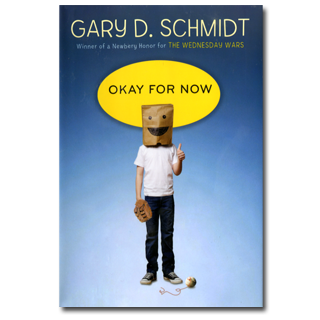
Do you remember when you first heard this cliche?   If you're like me, you probably wondered how the saying got started.   Your elementary school self probably wondered where are all of these ugly books were.   I never saw any.   And then I saw this...


Really?   This is the best you can do?

Ug.   I'm pretty sure I was the chump who put in a request for this book for our school library.   The reviews were spectacular.   So what's with the long face?

Even so, I grabbed the book and took it home yesterday.   Once I started, I was about 3/4 of the way through before I could stop.     This. Book. IS. Spectacular.  

The young man who narrates the story is full of pluck, humor, tenderness and goodwill.   In spite of some very hefty baggage, 14 year-old Doug Swieteck keeps getting back up and giving people second chances.   He is charming, even when he's not.   His character is often allowed to do the equivalent of a film actor looking right into the camera with a wink.   His voice doesn't give you a chance to disengage from the text.   Doug's not perfect; he'll tell you that.   It's through his imperfections that author Gary D. Schmidt creates a compelling character.

I read the book reviews and was perplexed about how Mr. Schmidt could integrate some of John J. Audubon's bird art into a young adult novel, but he does.   Perfectly.   You'll see.   There's a bit of Jane Eyre and Our Town...and a merciless gym teacher.   There's baseball, horseshoes and Coca-Cola in bottles.   There's a library, a girl and hope.

And there's a moment when you, dear reader, will hold your breath for a few pages.   The scene unfolds in slow motion.   Somehow Schmidt shifts your reading speed into first gear and harnesses the passing of time.   That's how great this story is.

Now that I sit down to write this, I am truly sad that Doug is a work of fiction.   On the other hand, who's to say that he's not?   We've all marveled at the resilience of children in spite of just about anything.  

In short, the goofy, superficial picture you see masks the captivating depth of this story.   The mood evoked by that image does not appear in the text.   That's not Doug.   But you've been preparing for this moment all of your life.   Don't judge this book by its cover.   Doug insists.

Tuesday, March 6, 2012

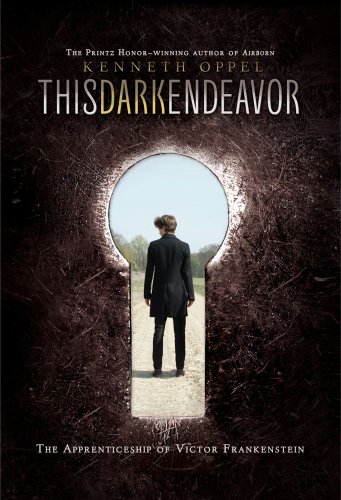
Radical Notions & This Dark Endeavor


Dear Mr. Oppel,

Aren't you clever?   This Dark Endeavor was totally YA.   Early Victor Frankenstein all wrapped up in raging hormones, demanding quests and daring feats of great strength.   Teens love that.   Being a Nancy Drew girl myself, you had me at secret passage.   And all of those little English major bits you hid from the kids...in plain sight!   The tiresome folks who always insist on laughing loudest when watching films of Shakespeare's comedies to make it very, very clear that they get all of the jokes (especially the ones that aren't particularly funny) will be all over that. 

The best part was your timing.   Or was it my timing?   This book was a welcome break from last weekend's breaking news.   You know that guy who gets paid to talk incessantly and anger women?   No.   The other one.   Yeah, him.   He was really pushing my buttons.   And I know that your book is fiction-- but your Margaret was top rate.   After all, if you're putting together a prequel worthy of Mary Shelley, daughter of Mary Wollstonecraft, you have to be serious about that undertaking.   Margaret was neck and neck with Victor and Konrad, even besting them on occasion.   After all, isn't that what we want teens to know about life?   We're all strong and weak, brave and afraid, AND passionate about being who we are, boys and girls alike.

And that scene when Margaret volunteers to be the one that--   You know what I'm talking about.   I couldn't stop thinking about it while I was gnawing on some slow roasted pork ribs that same night.   I did have the manners to keep that plot point to myself until my dinner companion was done for approximately two seconds.  

Thanks, Mr. Oppel, for being thoughtful in creating characters that run the spectrum of what being human is.   I'm glad for all of our students that this book now lives in our school library...and that there's a prequel sequel about to hit the shelves.

Truth sure was stranger than fiction last weekend.   I'm glad I had a good book to carry me through.   Thankfully art can keep one's soul afloat in times of truly dark endeavors.  


Saturday, March 3, 2012

The Real Anne Frank/ Part 2

After teaching "Anne Frank" for 13 years, I finally feel like I'm getting into my groove.   What's that?   Slow learner?   Well, maybe.   In the case of teaching real life stories that are enveloped in so many complexities, there's always room for improvement.  

If you read the first edition of The Real Anne Frank, you will remember my frustration with the Goodrich/Hackett and Kesselman texts.   In short, that which makes Anne of the real diary so compelling never seems to surface.   You'll also remember my excitement over the BBC miniseries.


This year I decided to mesh the two and add in a bit from the 1959 play.   This should work for you in classes where students read at or above grade level.   You will need to simplify it further for students who are are struggling readers.

In short, I introduced Anne by way of the BBC.   We watched the miniseries up to the point of the bathing scene.   I chose 10 of Anne's early diary entries for students to read, focusing on identifying conflict.   Students wrote a friendly letter to Anne offering advice on navigating her personal relationships with her family and the VanPels.   10 more entries were selected for a vocabulary exercise.   Each entry also represented an important plot point.   Students then used our laptop lab to visit the Secret Annex.  

We read the play from the cake scene to the date scene, because it's middle school.   Kids love the big date.   Okay, maybe I love it more.   That awkward first kiss is exactly the type of romance that some teenagers need to see, so they can relax a little.   This is the moment in the play when students really see themselves and their friends.   After this scene, writers draft a journal entry that Peter could have created to sum up the evening's experiences.


You may have also read the two sentence journal blog entry.   That's what we did with the last 10 teacher-selected diary entries.   Again, I chose 10 diary entries with important plot points.   The students stepped into Anne's point of view, determined the most important topic of the entry and condensed it into two sentences, capturing Anne's voice.

We then returned to the end of the play.   Students read Anne's real last diary entry.   I read aloud from  Miep Gies's account of the capture and the return of Mr. Otto Frank to the Annex.

Students spent a second session with laptops to Google questions that still lingered.   I also provided a list of 20 names, places and events related to World War II and the Holocaust for additional research.

For the duration, I kept a variety of books on related topics in the room for students to peruse during independent reading time.   Sneetches, Yertle the Turtle, Maus, and this year I added Andrew Clements's A Million Dots.   No, it's not really about the Holocaust, but you've probably figured out where I'm going with this.   By the end of Clement's picture book, you will have seen, yes, a million dots.   Imagine that each dot is a person's life.   Multiply the dots by at least six.   It helps quantify the incomprehensible.

A Million Dots

Throughout our Anne Frank unit, students read M.E. Kerr's Gentlehands independently.   When they were finished, they wrote a paper in which they argued whether Grandpa Trenker was a static or dynamic character using support from the text.  
 Gentlehands (Harper Keypoint Book)

Soon we will most likely watch Paper Clips for another perspective, but that's probably another blog entry.

Friday, March 2, 2012

This Middle School Life

One of the worst parts about winter is that I miss cutting the grass and keeping up with Ira Glass.   Time on my riding lawn mower is like a Zen meditation for me, and I frequently listen to an episode of This American Life on my iPod while I work.   I never feel like my day job is done until my 8th graders become 9th graders.   Mowing the lawn while enjoying a podcast provides a clearer finish line.

While I prefer my pod and yard time to be an escape, I couldn't help wanting to share Middle School with you.   The radio show anyway.   I'll admit that I didn't learn anything new, but the last act contains one of the most important life lessons of all.   We never know all of the challenges other people are dealing with, and this includes middle schoolers.   To me, this falls under the "love one another" umbrella.   Do you remember when you learned this lesson in your own life?   The moment when it comes home for us usually involves a hefty dose of humility.

Yes, middle school students love to put a lot of drama out there for anyone to see.    Yes, sometimes we can guess which children are struggling socially, academically and physically.   No, we will never be able to know everyone's burdens.   It's not realistic in either our teaching lives or our other lives.   For this reason alone, we should all remember compassion.   It's always the right choice when dealing with children.

I'm not talking about excuses, just empathy.   Middle schoolers have little control over many of the circumstances in their lives.   Offering strategies for success while they are at school can help them make good choices that impact their peace of mind while they are with you.

This is also not a time for moral judgment.   Not knowing other people's challenges also extends to what you  may or may not know about their parents.   Let me be clear.   If you suspect that a child is in danger, you should report it.   If you are merely falling victim to the blame game, it's another story.   You may be sure that the child is being poorly parented.   Don't waste any of your time thinking or talking about that.   What can you do as a professional teacher, not a parent,  to help usher that child toward success during the school day?  That's where your time is better spent.   That's where you have some control and expertise.

With respect to your subject area, what needs to happen between the school year's start and finish lines in an effort to send a more knowledgeable student on to the next grade?   Your curriculum should be a cornerstone, but it's also going to take a lot of flexibility, creativity and heart from both sides of the desk.

Thursday, March 1, 2012

Get Caught Reading


You've probably seen "Get Caught Reading" celebrity posters before.   
Teachers and librarians can get them free here --> The Association of American Publishers

They also feature a few "Get Caught Listening" posters.  
Please enjoy the following image of Mr. L.L. Cool J.


You're welcome.

They ask that we limit ourselves to 12 posters each and chip in $5 for shipping.   
Enough said.